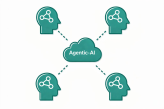
 Agentic AI Cheatsheet
An AI agent is simply a digital helper that can sense, think, and act on its own to reach goals.
Key Characteristics:
Autonomy: Operates without constant human intervention
Reactivity: Responds to environmental changes
Proactivity: Takes initiative to achieve goals
Social Ability: Interacts with other agents or humans
Agent Types:
Gen AI → Produces output (text, images, code)
Agentic AI → Produces outcomes (completed tasks, workflows)
Key Differences:
Planning: Decomposes goals vs just answering
Self-correction: Iterates on errors vs one-shot
Tools: Uses external tools vs internal knowledge
Autonomy: Acts on behalf of user vs waiting for prompts
AI Agent is a component. Agentic AI is the system.
AI Agent (Component):
Single function, reactive, narrow scope (e.g., Spam Classifier).
Agentic AI (System):
Multi-step workflows, proactive, broad scope, governed autonomy (e.g., Customer Service Platform).
Core Components:
Perception: Sensors/APIs to gather environmental data
Reasoning: Decision-making logic (LLM, rule-based, ML)
Memory: Short-term (context) and long-term (vector DB)
Planning: Strategy formulation for goal achievement
Action: Tools/actuators to interact with environment
Agent Loop:
1. Perceive → Observe environment state
2. Think → Process information & plan
3. Act → Execute actions via tools
4. Learn → Update memory & strategy
Memory Types:
Short-term: Current conversation context (LLM context window)
Long-term: Persistent knowledge (Vector databases)
Episodic: Past interactions (Traditional DB)
Semantic: Domain knowledge (Knowledge graphs)
Vector DBs:
Reasoning + Acting - Interleave reasoning and action steps
Thought: I need to find the current weather
Action: search("weather in San Francisco")
Observation: Temperature is 65°F, partly cloudy

Thought: Now I have the weather information
Action: respond("It's 65°F and partly cloudy")
Benefits:
Interpretable: Decision-making process is transparent
Dynamic: Task decomposition happens on the fly
Resilient: Error recovery through reasoning
Effective: Better handling of multi-step tasks
Inference infra, hosting, scaling.
Threats: Latency, cost spikes.
Controls: Caching, batching, fallbacks.
The "thinking brain": planning and verification.
Threats: Bad planning, logic errors.
Controls: Self-correction, multi-model verification.
Retrieves trusted knowledge (RAG).
Threats: Bad retrieval, outdated docs.
Controls: Hybrid search, reranking, citations.
Stores history, preferences, past tasks.
Threats: Hallucinations, poisoning.
Controls: Filters, expiry rules, scoped access.
Agent connects to tools like Slack, Gmail, DBs.
Threats: Tool misuse, API errors.
Controls: Permission boundaries, sandboxing.
Manages multi-step execution: plan → act → verify → deliver.
Threats: Infinite loops, deadlocks.
Controls: State machines, step limits, timeouts.
Where agents operate inside real products (CRM, support, ops).
Threats: Wrong actions, data leakage.
Controls: HITL approvals, RBAC, Audit logs.
Framework for building LLM-applications
from langchain.agents import initialize_agent, load_tools
from langchain.llms import OpenAI

# Define a simple LLM (replace with your API key)
llm = OpenAI(temperature=0, openai_api_key="your-openai-api-key")

# Load built-in tools or define custom ones
tools = load_tools(["llm-math"], llm=llm)

# Initialize the agent
agent = initialize_agent(
    tools, llm, agent="zero-shot-react-description"
)

# Run the agent
result = agent.run("What's 25% of 842?")
print(result)
Key Features:
Agent Types: Pre-built agent types (ReAct, Plan-and-Execute)
Tool Calling: Tool/function calling abstractions
Memory: Memory management (conversation, vector)
Chains: Chain composition for complex workflows
Integrations: 200+ integrations (LLMs, vector DBs, APIs)
Build stateful, multi-actor agents as graphs (by LangChain team)
from langgraph.graph import StateGraph

workflow = StateGraph(AgentState)
workflow.add_node("research", research_node)
workflow.add_node("write", write_node)
workflow.add_edge("research", "write")
workflow.set_entry_point("research")

app = workflow.compile()
Use Cases:
Multi-Agent: Multi-agent systems with coordination
Workflows: Complex, branching workflows
Human-in-Loop: Human-in-the-loop patterns
Cyclic: Cyclic agent behaviors
Stateful: Persistent conversation state
Microsoft's framework for multi-agent conversation systems
from autogen import AssistantAgent, UserProxyAgent

assistant = AssistantAgent("assistant")
user_proxy = UserProxyAgent(
    "user_proxy",
    code_execution_config={"work_dir": "coding"}
)

user_proxy.initiate_chat(
    assistant,
    message="Plot a chart of stock prices"
)
Key Strengths:
Code Execution: Automatic code execution in sandboxes
Collaboration: Multi-agent debate/collaboration
Patterns: Built-in conversation patterns
Feedback: Teaching/feedback mechanisms
Role-based agent collaboration framework
from crewai import Agent, Task, Crew

researcher = Agent(
    role="Researcher",
    goal="Find latest AI trends",
    backstory="Expert researcher..."
)

writer = Agent(
    role="Writer",
    goal="Write engaging articles",
    backstory="Professional writer..."
)

crew = Crew(agents=[researcher, writer])
crew.kickoff()
Features:
Role-Playing: Agent personas with roles and backstories
Task Execution: Sequential & parallel task execution
Orchestration: Process orchestration (sequential, hierarchical)
Delegation: Built-in delegation patterns
Data framework for LLM applications with RAG focus
from llama_index import VectorStoreIndex, SimpleDirectoryReader

documents = SimpleDirectoryReader('data').load_data()
index = VectorStoreIndex.from_documents(documents)

query_engine = index.as_query_engine()
response = query_engine.query("Summarize the document")
Best For:
RAG: Retrieval-Augmented Generation
Document Q&A: Document question-answering systems
Knowledge Base: Knowledge base integration
Connectors: Data connector ecosystem (100+)
Microsoft's SDK for integrating LLMs into applications
import semantic_kernel as sk

kernel = sk.Kernel()
kernel.add_text_completion_service("gpt", OpenAITextCompletion())

skill = kernel.import_semantic_skill_from_directory("./skills")
result = await kernel.run_async(skill["Summarize"])
Features:
.NET Integration: Enterprise-grade .NET integration
Skills/Plugins: Skills/plugins architecture
Planner: Planner for automatic orchestration
Memory: Memory connectors
Enable agents to use external tools and APIs
tools = [
    {
        "type": "function",
        "function": {
            "name": "get_weather",
            "description": "Get current weather",
            "parameters": {
                "type": "object",
                "properties": {
                    "location": {"type": "string"}
                }
            }
        }
    }
]

response = client.chat.completions.create(
    model="gpt-4",
    messages=messages,
    tools=tools
)
Best Practices:
Naming: Clear, descriptive function names
Parameters: Detailed parameter descriptions
Error Handling: Error handling and validation
Rate Limiting: Rate limiting and retries
Logging: Logging for debugging
Improve reasoning by making agents think step-by-step
Encourages detailed, logical problem solving
Prompt: "Let's solve this step by step:

1) First, identify what we know
2) Then, determine what we need to find
3) Break down the problem into smaller steps
4) Solve each step
5) Combine the results

Problem: If a store has 25% off sale..."
Variants:
Zero-shot CoT: "Let's think step by step"
Few-shot CoT: Provide example reasoning
Self-Consistency: Sample multiple paths, vote
Tree of Thoughts: Explore multiple reasoning paths
Enhance agents with external knowledge retrieval
Feeds context to LLM & reduces hallucinations
1. User Query → Embed query into vector
2. Vector Search → Find relevant documents
3. Context Assembly → Combine top-k results
4. LLM Generation → Generate with context
5. Response → Return grounded answer
Implementation Tips:
Chunking: Chunk documents (500-1000 tokens optimal)
Embeddings: Use semantic embeddings (OpenAI, Cohere, local)
Reranking: Implement reranking for better results
Filtering: Add metadata filtering (date, source, type)
Monitoring: Monitor retrieval quality metrics
Agent evaluates and improves its own outputs
Loop:
1. Generate initial response
2. Critique: "What are weaknesses in this response?"
3. Refine: "Improve based on critique"
4. Repeat until quality threshold met

Example:
- Generate code
- Check for bugs/inefficiencies
- Refactor and improve
- Validate against requirements
Techniques:
Self-Refinement: Iterative improvement
Constitutional AI: Critique against principles
Debate: Multiple agents critique each other
Separate planning from execution for complex tasks
Phase 1 - Planning:
- Analyze goal
- Break into subtasks
- Order dependencies
- Create execution plan

Phase 2 - Execution:
- Execute each subtask
- Monitor progress
- Handle failures
- Adapt plan if needed
Benefits:
Multi-Step: Better handling of multi-step tasks
Tracking: Clear progress tracking
Debugging: Easier debugging and recovery
Efficiency: Reduced token usage (plan once, execute many)
Multiple specialized agents work together
Patterns:
Debate: Agents argue different perspectives
Delegation: Manager assigns tasks to specialists
Cooperation: Agents work on shared goal
Competition: Best solution wins
Example Roles:
Define measurable outcomes (KPIs, latency, accuracy). What does 'done' look like?
Break complex goals into executable subtasks. Define dependencies and hand-offs.
Select LLMs, vector DBs, and frameworks (LangGraph, CrewAI) based on requirements.
Set up short-term context and long-term knowledge retrieval.
Implement safety layers, human-in-the-loop, and continuous evaluation.
Models:
- GPT-4 Turbo: Best reasoning, function calling
- GPT-4o: Multimodal, fast, cost-effective
- GPT-3.5 Turbo: Fast, affordable
from openai import OpenAI

client = OpenAI(api_key="...")
response = client.chat.completions.create(
    model="gpt-4-turbo",
    messages=[{"role": "user", "content": "Hello"}],
    tools=[...]  # Function calling
)
Best For:
Reasoning: Complex reasoning tasks
Tool Calling: Function/tool calling
Structured Output: JSON mode for structured output
Models:
Claude 3.5 Sonnet: Best overall, 200K context
Claude 3 Opus: Most capable
Claude 3 Haiku: Fast, affordable
import anthropic

client = anthropic.Anthropic(api_key="...")
message = client.messages.create(
    model="claude-3-5-sonnet-20241022",
    max_tokens=1024,
    messages=[{"role": "user", "content": "Hello"}]
)
Strengths:
Context: Long context (200K tokens)
Quality: Excellent at analysis and writing
Safety: Strong safety features
Popular Models:
Llama 3: Meta's latest (8B, 70B, 405B)
Mistral: Efficient European models
Mixtral: Mixture of Experts (8x7B, 8x22B)
Gemma: Google's lightweight models
Phi-3: Microsoft's small models
Deployment Options:
Providers:
Cohere: Embeddings, RAG, multilingual
Together AI: Open model hosting, inference
Replicate: Easy model deployment
Hugging Face: Model hub, inference API
Anyscale: Ray-based scaling
Databases:
Pinecone: Managed, scalable (Cloud)
Weaviate: GraphQL, hybrid search (Cloud/Self)
Chroma: Lightweight, dev-friendly (Self)
Qdrant: High performance, Rust (Cloud/Self)
Milvus: Large-scale, production (Cloud/Self)
pgvector: PostgreSQL extension (Self)
Popular Models:
text-embedding-3-large: 3072 dims (OpenAI)
embed-english-v3.0: 1024 dims (Cohere)
all-MiniLM-L6-v2: 384 dims (HuggingFace)
bge-large-en-v1.5: 1024 dims (BAAI)
Use Cases:
Search: Semantic search in knowledge bases
Similarity: Document similarity
Classification: Clustering and classification
LLM Observability:
LangSmith: LangChain's debugging platform
Weights & Biases: Experiment tracking
Arize AI: LLM monitoring & evaluation
Helicone: LLM logging & analytics
Traceloop: OpenTelemetry for LLMs
Key Metrics:
Latency: p50, p95, p99 performance
Costs: Token usage & costs
Errors: Error rates & types
Satisfaction: User satisfaction scores
Tool Success: Tool calling success rates
Frameworks:
LangChain Eval: Built-in evaluators
PromptFoo: Test prompts, compare models
RAGAS: RAG system evaluation
Deepeval: Unit testing for LLMs
TruLens: Feedback & evaluation
# Example evaluation metrics
- Correctness: Does it answer correctly?
- Relevance: Is response on-topic?
- Faithfulness: Grounded in context?
- Coherence: Logical and consistent?
- Helpfulness: Useful to user?Core Principles:
Be Specific: Clear instructions and context
Use Examples: Few-shot learning works well
Set Constraints: Format, length, style requirements
Chain Prompts: Break complex tasks into steps
Iterate: Test and refine prompts
Good Prompt Template:

Role: You are an expert [domain] assistant
Context: [Relevant background information]
Task: [Specific task description]
Format: [Output format requirements]
Examples: [1-3 example inputs/outputs]
Constraints: [Any limitations or requirements]Strategies:
Retry Logic: Exponential backoff for API failures
Fallbacks: Backup models or degraded modes
Validation: Check tool outputs before using
Timeouts: Prevent hanging operations
Circuit Breakers: Stop cascading failures
try:
    result = agent.run(query)
except RateLimitError:
    time.sleep(exponential_backoff())
    result = agent.run(query)
except InvalidToolOutput:
    result = agent.run_with_fallback()
finally:
log_metrics(result)Techniques:
Model Selection: Use appropriate model for task
Caching: Cache similar queries and embeddings
Context Management: Trim unnecessary context
Batch Processing: Group similar requests
Streaming: Start processing before full response
Model Recommendations:
Simple Q&A: GPT-3.5, Claude Haiku
Complex Reasoning: GPT-4, Claude Opus
Long Context: Claude (200K)
Code Generation: GPT-4, Claude Sonnet
Considerations:
Input Validation: Sanitize user inputs
Output Filtering: Check for harmful content
Sandboxing: Isolate code execution
API Key Management: Secure credential storage
Rate Limiting: Prevent abuse
Audit Logging: Track all agent actions
# Security checklist
✓ Never expose API keys in code
✓ Use environment variables
✓ Implement content filters
✓ Validate all tool outputs
✓ Set execution timeouts
✓ Log security events
✓ Regular security auditsCapabilities:
FAQs: Answer FAQs using knowledge base (RAG)
Tickets: Ticket creation and routing
Status: Order status lookup via APIs
Sentiment: Sentiment analysis and escalation
Multi-language: Multi-language support
Tools Needed:
Capabilities:
Calendar & Email: Calendar and email management
Tasks: Task planning and tracking
Information: Information retrieval
Scheduling: Appointment scheduling
Reminders: Reminders and notifications
Integrations:
Capabilities:
Search: Web search and information gathering
Analysis: Document analysis and summarization
Extraction: Data extraction and structuring
Intelligence: Competitive intelligence
Reports: Report generation
Architecture:
Researcher: Gather information
Analyst: Process and analyze
Writer: Create reports
Critic: Review and refine
Capabilities:
Generation: Generate code from requirements
Review: Code review and bug detection
Refactoring: Refactoring suggestions
Testing: Test generation
Documentation: Documentation creation